What’s the difference between funding and financing?
Written by: Zach Knight, Blue Forest CEO & Co-Founder
Landscapes across the Western U.S. need restoration faster than traditional systems can deliver it. The tools to move faster exist, but one of the quieter barriers to scaling them comes down to two words that often get conflated: ‘funding’ and ‘financing.’ When the distinction gets lost, we leave a potential force multiplier on the table — one that could close the cash flow gaps slowing restoration down, stretch funding dollars further, and accelerate urgently needed restoration across landscapes.
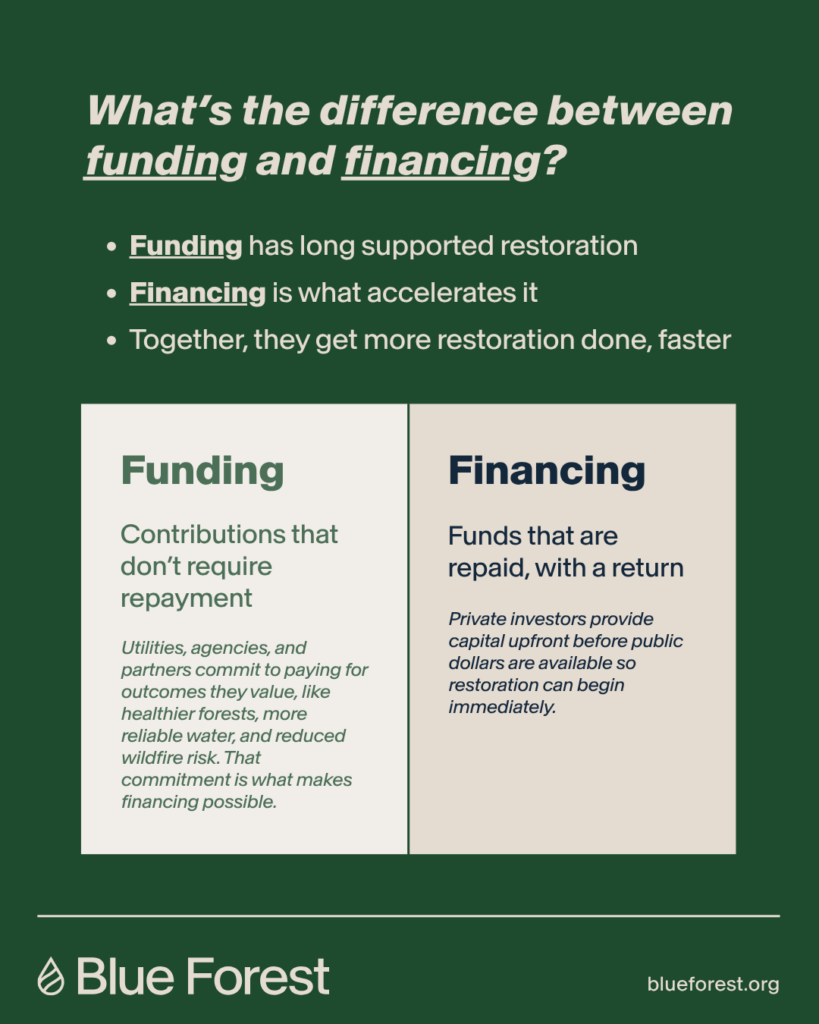
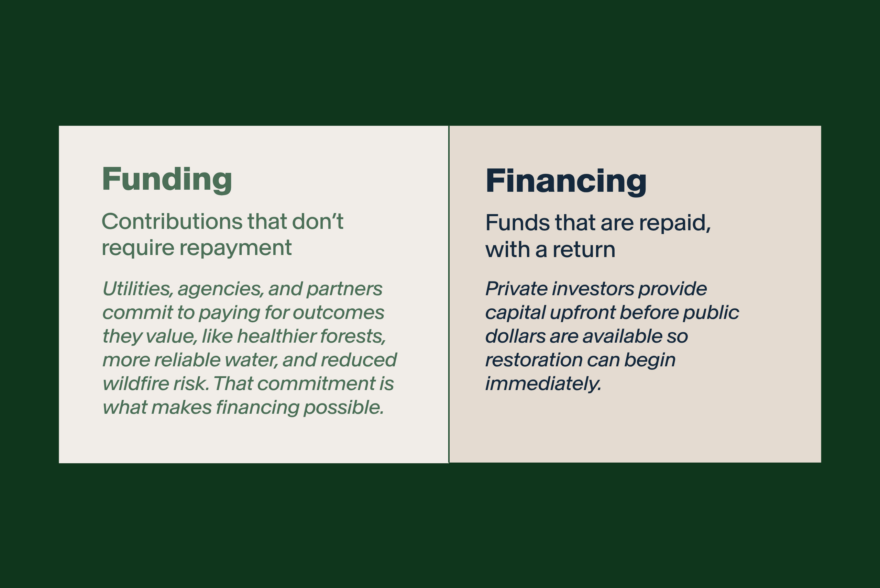
Funding is a commitment to pay for the inputs and activities, and hopefully more often, the outcomes you value. When a water utility contributes to a restoration project, they’re not expecting repayment. They pay into the project as a form of infrastructure maintenance, because healthy forests protect their water supply, reduce the risk of wildfire-degraded water quality, and ultimately serve their ratepayers. The return is real, but instead of registering on a balance sheet, it flows back to their infrastructure and the people they serve, coming in the form of reduced operational risk, lower treatment costs, and more reliable water supply.
Financing is different. It’s upfront capital from investors who do expect a financial return, ranging from concessional to commercial. In forest restoration, financing is what solves the problem of urgency. Instead of waiting months for public funding to work its way through traditional systems, private capital bridges the gap, enabling contractors to get paid in days rather than months, which is especially important when working to build local capacity. With financing, work that might otherwise take a decade can happen in a fraction of the time.
In the Forest Resilience Bond model we’ve built at Blue Forest, funding and financing work in lockstep: funders — utilities, agencies, and corporate partners — commit to pay for activities and measurable outcomes, and that commitment is what makes financing possible. Private capital flows upfront to bridge the gap between work completion and funder reimbursement, investors are repaid as restoration is completed, and projects move significantly faster than traditional funding cycles allow.
When funding and financing work together, what emerges is this system we call conservation finance, and it’s a relatively new way of thinking about how to restore ecosystems more efficiently. A decade ago, you couldn’t point to many examples of it working. Today it’s operating across hundreds of thousands of acres in the Western U.S., across landscapes that filter drinking water for millions and, when properly restored, are far less likely to burn catastrophically — and the pipeline is growing.